May 2026
M T W T F S S
 123
45678910
11121314151617
18192021222324
25262728293031

On Winter’s Doorstep?

With any thoughts of Indian Summer weather long gone and Halloween approaching – is winter far behind?

The benefit (and detraction) of living in a high desert-alpine climate is that weather change can be quick, certain and dramatic.  A bright warm fall with vibrant colors was given a cease-and-desist order by the Weather Department and replaced cold temperatures with gray overcast sky filled with extended periods of light snow.  As I felt the onset of seasonal affected disorder, the weather turned to cold temperatures with bright blue sky.

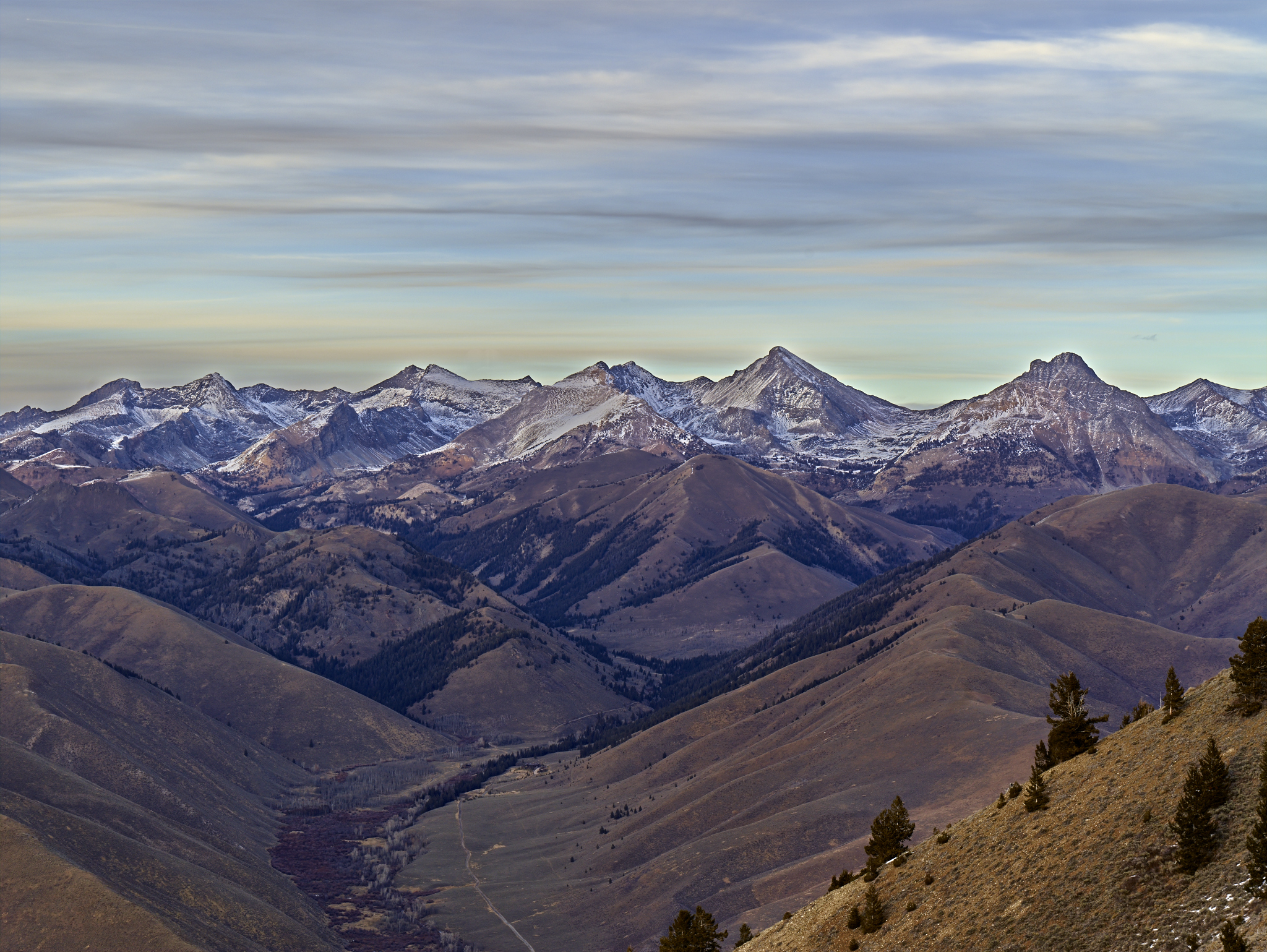
The snow in the upper elevations is probably here to stay.  The implication is that my the three hikes/runs have provided a light base of snow on the trail.  The dogs (Shae and Merry) are loving it as am I.  The Sun Valley Company has the snow making apparatus at full throttle on both Baldy and Dollar – the cold temperatures really, really help.

The first lasting snow of Fall 2012?; Sunset From Carbonate Mountain.
Jeffrey Lubeck – Cambo Wide RS, Schneider 120MM, Phase One IQ180 @F8 1/60th second ISO 35

Triple Crown and Double Dip

As the saying goes, last is not necessarily the least.  On Thursday, the statement could not be more applicable as Kyle and I successfully complete summiting (in 2012) the last of the highest peaks in the five mountain ranges (Pioneer, Boulder, Sawtooth, White Cloud and Smoky) surrounding the house.  The last, Saviers Peak at 10,441 is the tallest in the Smoky’s and is named after Mr. & Mrs. George Saviers who summit-ed the peak on their honeymoon and left a register in a band-aid can.  What made the trip noteworthy for us is that we decided to go for four named (Saviers, Bromaghin, Titus and Lower Titus) and two unnamed peaks (9,921 and 9,636) in one day.  With the task completed and a wonderful lunch consumed in the warming sun, we turned around and retrace our route over the peaks a second time before returning home.  Kyle and I picked Thursday, given that wet snowy weather was forecast to start on Friday.

There are two principle routes to the top of Saviers. One is via the Owl Creek drainage.  The other is via the Smoky’s Traverse starting from Galena Summit.  Virtually all of the notes from Summit-er’s on both routes say to expect a long arduous (10+ hour) day replete with endless talus slope and scree [i.e, two steps forward and one, possibly two, and even three back] on steep terrain ending with class 3 route finding amongst never ending rock towers.  Kyle and I both read notes and a description from two guys (in 2001) that strongly recommends hiking to the ridge-line and staying on it through every up and down all the way to Saviers.  The theory being that despite the extra distance, elevation and class 3 exposure – the hike/climb will actually be easier, more enjoyable and you will bag four named peaks as well.

300+ degree view on Thursday morning

Similar to our approach with Castle Peak, Kyle and I arrive and leave the trail-head about 18 minutes before sunrise. Although Sun Valley has been home full or part time for approaching 30 years, I reveal the Detroit-er in me as I want to call it White Castle.

Kyle and I find a faint trail on the north side of Galena Summit and work our way through an area that is heavily forested.  I really like this section of trees because when viewed from the road across drainage while heading up to the pass from Stanley they look like a impressionist work by Monet.  For the first time since hiking early in springtime, the ground is hard from the freezing temperatures.

The sun presents itself as Kyle and I reach our first peak – 9,636.  To the right, the Sawtooth and White Cloud mountains are starting to soak in the suns’ rays.  Down below – still in shade – is the Sawtooth Valley.  The Salmon River (a.k.a. The River of No Return as named by Lewis and Clark) is framed by the red tinges of Arctic Willows no longer bearing leaves. My eyes follow the Salmon River back to its source one drainage over.  I think fondly back to my solo adventure in mid September when I hiked to the headwaters of the Salmon.

Next up is unnamed peak – 9,921. Kyle and I follow the ridge-line.  To our left, some 1,100 feet below is Titus Lake. The lake and peaks are named after William Titus a member of the 1915 USGS Survey party. After reaching peak 9,921 Kyle and I descend a few hundred feet and then back up towards the next goal – Lower Titus Peak (10,005).  We follow a faint trail and stay on the ridge-line.  The trees are now all but gone and the going is mostly cross-country.  The sun is out, but the slightest of breezes and low temperature keeps things feeling brisk.  Lower Titus Peak has an object on top that clearly looks like a NOAA weather station.  After arriving on top our assumption is proven correct. I ask Kyle to give his weather forecast.

Next up… its Kyle with today’s AccuWeather forecast.  The Sawtooth Mountains and Thompson Peak are in the background on the left.

In the distance is our next goal – Titus Peak (10,110).  To get to Titus Peak, Kyle and I descend about 500-600 vertical and then scramble up and over a number of smallish crags and rock towers.  This is our first taste of some route finding.  The going is straight forward.  We arrive at what we initially think is Titus Peak, but the summit is a quarter-to one half mile away.  Kyle and I move on using a nice pace and quickly reach and confirm Titus Peak by the geological marker.

Next up is Bromaghin Peak (10,225).  It is located south and west of Titus and is named after Captain Ralph Bromaghin a ski instructor at Sun Valley and member of the 1oth Mountain Division of the US Army who gave his life on our behalf in World War II.  To reach the peak, Kyle and I need to drop 500-600 feet on the ridge line and then ascend to the summit.  The effort to reach Bromaghin is slightly more demanding but very straight forward and enjoyable as the hand and foot placements are on average very secure.  Bromaghin is a big block and quite a bit craggier than Titus but appears to be somewhat less than Saviers.

The route from Bromaghin to Savier’s includes the same kind of drop and ascent Kyle and I have have experienced on the route to this point.  Also, there is a smallish unnamed peak – 10,182 between Bromaghin and Saviers. In reality there are a number of towers to go up, over and down before reaching the saddle area. From the saddle a significant amount of towers will also have to be dealt with on the route up to the eventual summit of Saviers Peak.  All of this stretch involves classic class 3 route finding.  My experience is that if you are patient, the trip is really fun to experience with a teammate.  On the route down to the saddle from Bromaghin Peak, Kyle and I stay, for the most part, on the left edge of the ridge-line.  The drop off on the left is precipitous, with a quick fall of 1,500-2,000 vertical feet.  However, the footing is really good.  The drop to the right is not as significant, but is made up of the dreaded scree.  Once down to the saddle we head up to Saviers staying on the right edge of the ridge-line.  Kyle and I encounter about six significant towers that we must climb up and then over and down.  On the fifth tower Kyle determines, that an ascent will leave us with a class 4-5 route to the top.  We decide to descend down into the dreaded scree and traverse – staying as high as possible.  The route to the summit becomes clear to us and we reach the summit with relative ease.

There are many Towers on the last one-half mile to the top Saviers.

On the summit of Saviers all five mountain ranges and the peaks we have summit-ed are easily within view.  Kyle and I find a nice spot just over the summit facing to the south the offers the warmth of the sun.  After lunch we pack up and head back using the same route.  Heading back over the same peaks is quite enjoyable. To our surprise the total time including one-half hour for lunch and an hour of photos is a little less than eight hours.

There appears to be a scoreboard on the way back to the trail-head. We each add a stick.


The Jeep awaits our return.


(Barely) Equal to the Challenge of Castle Peak

Reading about or listening to people discribing their attempt to summit Castle Peak reveals some common themes; “difficult”, “demanding”, “confusing”, “frustrating”, “painful”, “never ending” and “silly of me to attempt.” I, along with my son Kyle, decided to establish if any or all of these statements about the 15.5 mile (6,628 of vertical) trip to the 11,815 foot summit of the highest peak in the White Cloud Mountains of Idaho were true.

The first thing I found out is that round trip is 1.5 miles longer than any writeup suggests. The second is that everyone’s description of the last 400 feet of vertical being a confusing mix of narrow class 3+ corridors and gulley’s is true.  The third is that no one bothers to mention is that in addition to the 5,600+ vertical to the top of Castle Peak, you will have to be ready for another 1,000 of vertical gain on the return trip back to the trail-head (300 of which is in the last mile).

I also learned (painfully) something about myself.  Despite hiking to a goal similar to that of Castle Peak about every other week this season, I handicap myself significantly (to the point of almost breaking) if I have not slept more than four hours on any of the three nights leading up to the ascent and have worked five straight 12 hour+ days.  As Kyle said to me about 600 feet from the summit, “kind of hard to operate when the batteries have been run down to nothing.” Simply put I had no reserves available to me on this day. Luckily Kyle had a fully charged battery and helped guide me to the summit.

Castle Peak just after sunrise from the saddle overlooking Chamberlain Basin (9,852 feet elevation).

I was told by a few people that attempting Castle Peak from the south and the Chamberlain lakes basin might involve up to 15 hours of effort start-to-finish. Given this situation, the majority attempt Castle as part of a multi-day camp out with most using the lake at 9,197 as a base.  Kyle desired to try Castle in one day using the house as the starting point.  Seeing we had taken this approach all season – I agreed. However, given it was now October we would need options (i.e., headlamps, different types of clothing) as backup and start out from the house well before sunrise. I have been part of many hikes and competed in many ultra-marathon back-country mountain endurance races, so I knew what we needed to do and have at our disposal.

The first cold front of the fall entered the region on Wednesday.  Therefore I knew that although the weather was going to be sunny and free of precipitation the temperatures were going to be lower than normal.  Both Kyle and I prepared for the possibility. Driving to the trail-head the temperatures hovered between 12-15 degrees Fahrenheit.  The trail-head is 11 miles in from Highway 75 (Valley Road just south of Smiley Creek) and becomes a lightly traveled forest service road/jeep trail (Pole Creek) that gains, drops, gains and drops about 2,000+ vertical feet and involves three water fording.  The Jeep Grand Cherokee has been up to these kinds of conditions this year and handles the challenge with plenty of room to spare.  The trail-head is on Washington Creek and at 8400+ plus elevation.  The trip takes us 1:40 start to finish.

With the sun less than 15 minutes from rising Kyle and I head out in 15 degree temperature (7:55 AM).  We set a fast pace to get warm.  The trail-bed is in very good to excellent condition.  However, I just do not feel like myself – but the going is smooth, the pace seems appropriate and the terrain and views are awesome. Along the way Kyle and I follow all the ground rules of staying hydrated and taking in small amounts of fuel.

On the way to Castle Peak about 1/2 mile on the south side to the saddle (9,852 feet elevation) overlooking Chamberlain Basin and onto Castle Peak.

We arrive at a saddle that allows us to look at both the Boulder Mountains to the south and east and upon turning the other way – down into the Chamberlain Basin and Castle Peak to the north and west.  The views are breath-taking.  From the saddle we drop down into a set of lakes with the unnamed lake (at 9197 feet) sitting at the base of the ascent.

Looking west at the setting moon from lake 9197.


The route to the summit of Castle Peak up from the lake at 9,197)

At the lake 9,197 the trail T’s into a another trail that heads west and east.  There is no real trail from this point to the summit which is 2,618 feet above all of which is to be gained in a little over a mile.  Kyle and I water up, split an energy bar and carefully go over maps and descriptions by others who have attempted to summit via this route.  It should be noted these descriptions are at times vague and conflicting.

I will now use some words and phrases to describe the next 2,000 vertical feet of the ascent.  Cross-country, loose scree, kinda looks like a trail, couloir, huge waterfall at some time during the year, bolder hopping. really fun bolder hopping, class 2+ section, gully, really nice low class three section with really good holds, nasty ancient rock that produces small slides, and 2 steps up and 3 steps back.

With about 600 vertical feet left, Kyle can clearly see I am not keeping our normal pace – not even close to the one on the Class 3 section of Thompson Peak last week.  My legs feel strong and I feel no more winded than that on Hyndman Peak.  However I have no energy or reserve to draw upon.  We asses the situation and both agree I can make it to the summit but not at our normal pace.  Kyle makes a nice adjustment and keeps his eye on me. We also agree that we need to stop and re-access the final route as we close in on the summit.

At about 75 – 100 feet from the summit there are a number of gully’s and gaps before us.  The reason for the name Castle Peak becomes very obvious to me as there appears to be about 15 turrets representing what could be the summit.  We read the notes from each of the narratives and all it does is add confusion.  Kyle and I agree it is time to take off the packs and scout the area and talk about which way makes sense.  Kyle climbs to a couple of spots that seem like the logical summit and visually sights what he thinks is the highest.  Some of the descriptions from the narratives are not what we (or the most detailed map) indicates is the top.  What Kyle thinks (and the most detailed map indicates) is the top is our choice.  The good news is that this break for sighting has allowed my energy to return and the last piece of gain and solid class 3+ climb is actually enjoyable.

We eat lunch and take pictures using the camera gear I have lugged to the summit (of which I have seriously questioned its value on this day).  It should be noted that the picture below is almost three feet high by five feet wide at 100% resolution (i.e., no enlargement).  This image printed on satin-canvas is nice looking to some.  The image has been reduced by over 90% to fit on the screen.


From the top of Castle Peak looking north.


Kyle at the top of Castle Peak after a spot of lunch.


Kyle and I head down the route we came.  The first 1,500 vertical are less fun than the ascent. However, it is not about stamina – its is about falling debris. Kyle and I agree that we need to navigate more closely as a group one section at a time in order to avoid being hurt/seriously injured/killed by falling debris.

Looking onto the Boulder Mountains during the descent from Castle Peak.


Once down to lake 9,197 we power up to its sister lake and then to the saddle at 9,852. For some reason my energy has returned.  Creek beds with little frozen waterfalls form this morning remain frozen. At the saddle, I take a shot of Castle Peak at sunset.

Castle Peak at sunset from the saddle at 9,852.

Years ago my friend Mark Curtis taught me some techniques using varying strides on downhill returns.  Sometimes downhill routes at the end of a hike can be tiring and injury riddled.  Seeing my energy level is surprisingly good, Kyle and I agree I will lead and set a very brisk pace, in the hopes we we get back to the Jeep before headlamps are required.  Both of us carry a really strong pace – even over the last mile and last 300 vertical feet of gain at the finish.  We arrive at the Jeep at little after 7:30PM (7:38).  We made it.  So in about 11:45 we summit-ed Castle Peak, took photos for 1.5 hours along the way, had a nice lunch and returned to our vehicle without needing to use our headlamps.  After a full change of clothes and footwear we are on our way home.  We get back to the house a little before 9:30. Linda has the Tiger’s playoff game and Spartan’s football game recorded and ready for viewing, while downing some Pizza and garlic bread.

Oh and what about all those words and phrases I was attempting to uncover if they were true or not?  How about true! (but also add the word awesome).


The route to the summit of Castle Peak according to the GPS tracking on my watch and Google Maps