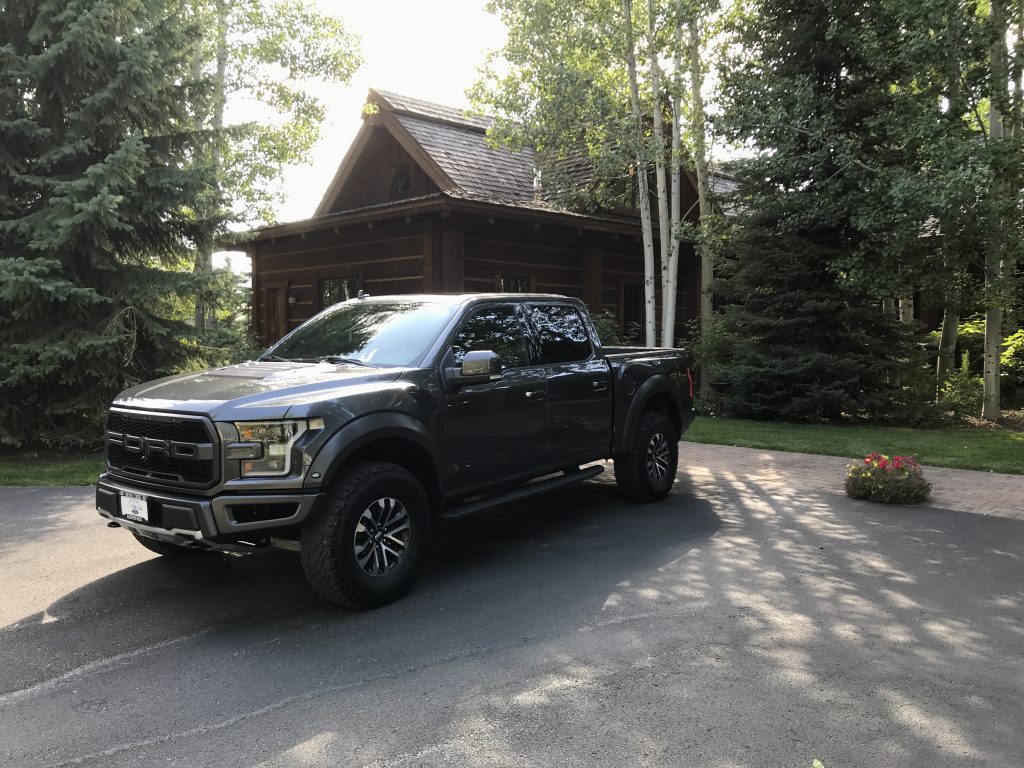
The Cherokee moves to the history books and the Raptor enters the scene.
My 2012 Jeep Grand Cherokee Overland has been retired as my Rig for Backcountry Photo-shoots. It served me exceedingly well for over 7 years.
I took possession of the Jeep at the end of June 2012. After months of intense research and test drives the Jeep was deemed to be the very best at meeting my need to travel almost anywhere (i.e., local, highway, forest service roads, off trail routes).
The Jeep as outfitted allowed me to travel with all the creature comforts I desired and also get me to the top of places such as Minebender with plenty of vehicle remaining. Many of my photo-shoots relied entirely on the Jeep getting to a crucial spot in the remote backcountry.
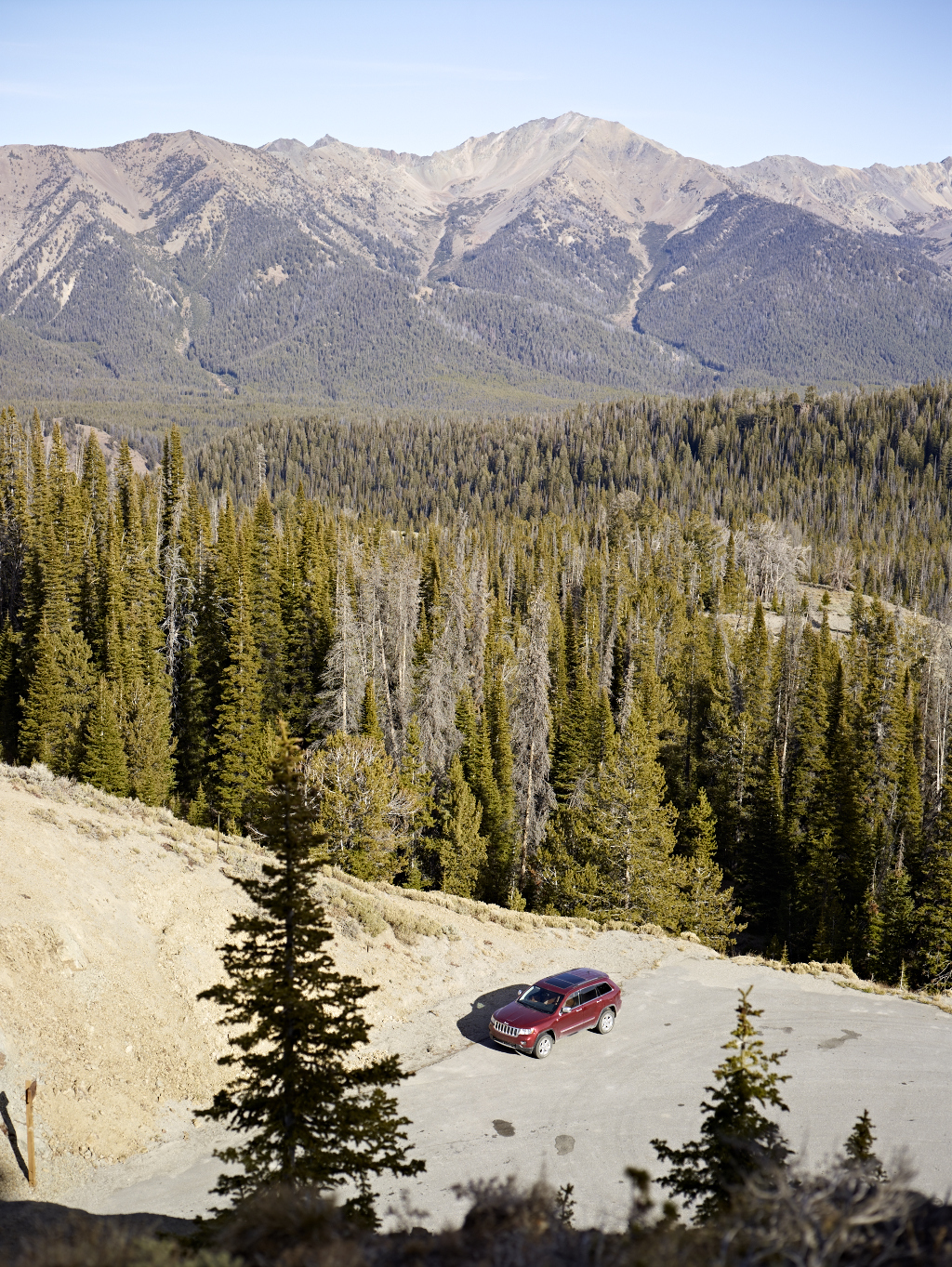
Sitting at Galena Summit in 2013, The Jeep awaits our return (Kyle & Jeff) from summiting four peaks. It is in one big day; Lower Titus, Upper Titus, Bromaghin and Saviers – the tallest in the Smoky Mountain Range. In the distance is Ryan Peak, the tallest in the Boulder Mountain Range which we summited weeks earlier.
About 40 days into ownership of the Jeep, the Halstead Fire of Idaho began on August 6, 2012. The Halstead would become a large monster – burning up 179,000 + acres in the Sawooth and Salmon-Challis National forest. A great deal of the timber that would succumb to the fire was virgin forest.
A good deal of what remains as virgin forest in the Continental United States is located in Idaho.
The fire started as a result of a lightning strike; so nature rules.
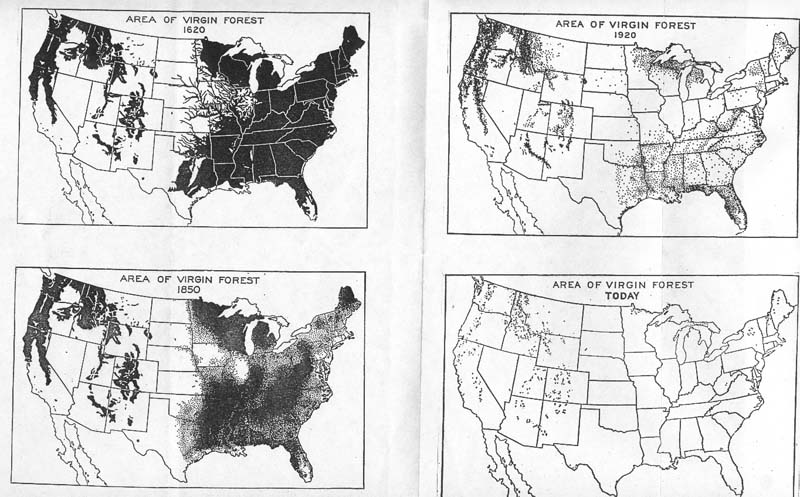
Following the same kind of natural selection or evolution process, the Jeep needed to make way for a new Rig.
Unfortunately, Fiat Chrysler decided the 2019 Jeep Grand Cherokee Overland would no longer make available the creature comforts of its 2012 predecessor. So the Jeep was taken off the list of possible replacements.
So what is my selection criteria? Go anywhere in practically any condition with all the right gadgets, have good creature comforts such as a top notch sound system, drive nicely on the highway, accommodate the dogs, accomodate my gear, tow a 23 foot boat and not break the bank. Yes… in short, have my cake and eat it too.
The final candidates using the selection criteria were the 2019 Mercedes G-Wagon, the 2019/20 Range Rover Sport HSE/SVR and the 2019 Ford Raptor.
Oh, yes, the Rolls Royce SUV is turning out to be everything promised. However, the last time I looked I was a smidge short of the $325,000 needed for purchase. Plus British edicate requires purchasing the services of a full-time driver.
The G-Wagon with its military linage is accompanied with every possible feature and function anyone would want. In 2019 Mercedes re-built the G-Wagon from the ground up. Different than its predecessors the 2019 G-Wagon drives as wonderfully on the road as off.
The Range Rover is a superb vehicle and was leading the race late in the selection process. The Land Rover dealer Lyle Pearson in Boise is well known to us for other cars we own and have owned. They are a great dealership. The demand for the Ranger Rover is high.
One small problem for Jeff… no dealers in the United States (I mean none) outfit the Range Rover Sport HSE/SVR to its full backcountry potential. Land Rover is known for its foo-foo features. I wanted less of those but everything needed to get me anywhere. So while Land Rover sells the concept of its unequaled ruggedness and comfort it appears no dealers or Americans actually want or use them. So in order to get what I wanted I would need to order the vehicle. Despite the best efforts of Lyle Pearson, delivery time ETA was 4-5 months.
The situation for the Ford Raptor was even more dire. For most of 2019 demand exceeded supply. No Raptors were available in the region – none.
Luckily I had purchased an 8 year 100,000 mile bumper-to-bumper repair coverage plan for the Jeep, so I could be patient.
During the search process, the Jeep while awesome, was starting to show a need for servicing. Also, the local Jeep dealership had left the area. So, I was now being forced to take trips to Twin Falls (71 miles away). The dealership in Twin Falls (Lithia) was nice and accommodating but the travel time and (free) rental car hassle was beginning to prove problematic.
While having a cup of coffee in Twin Falls waiting for The Jeep to be serviced, and coming to the conclusion I would buy a Range Rover and wait five months for delivery, I decided to look and see if any Raptors were available in the region.
Ironically our local dealership (Silver Creek Ford) that is allocated 1 or 2 Raptors a year (at least that is what they told me in April) has one on the lot. It had arrived the day before. Even stranger, the vehicle was outfitted exactly as I desired (down to the color). In short, this Raptor had all the goods but without three features – none of which I wanted. The features were two graphics packages (i.e, RAPTOR) that scream-out on the vehicle and some type of Carbon-fiber coffee holder and steering wheel trim.
Another advantage coming into play is I know and like the people at Silver Creek Ford and the purchase is local. The dealership even let us (Kyle and I) drive to Galena Summit and on the Boulder Creek jeep trail as the final test drive.
A deal is made.
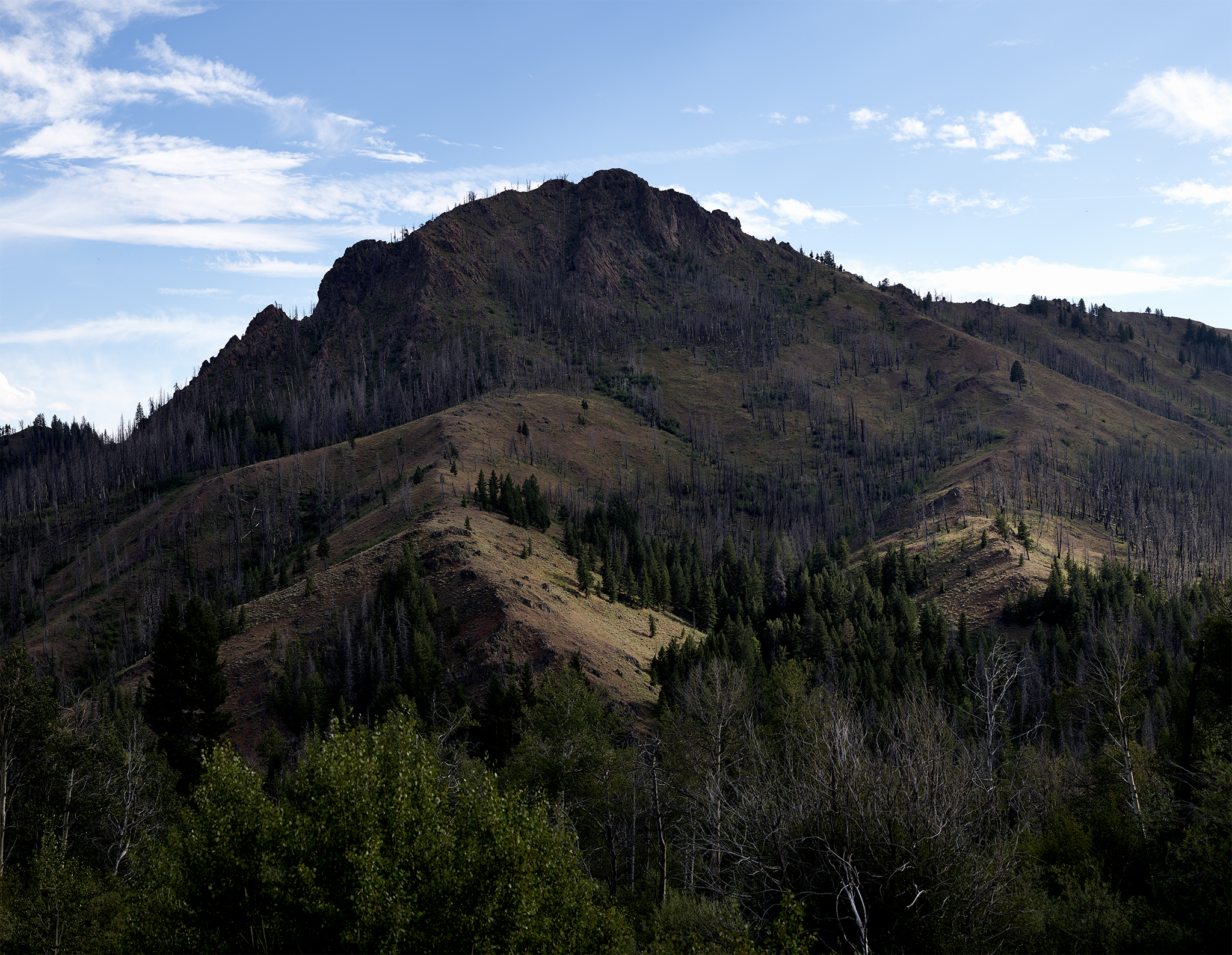
As for the Raptors first big test, I decide to venture back into where the Halstead Fire completed a Hard-Burn seven year previous.
As a brief backgrounder, wildfires in the Western U.S. recently have burned at an unprecedented rate since accurate and verifiable records have been maintained. Fires in 1910’s, 1930’s and late 1950’s were substantial but no reasonable comparison from a statistical perspective can be made. There was a material drop in wildfires from the 1960’s up to the late 1990’s. The increase since 2000 is material.
This post is not about climate change or a lack there-of and the reasoning behind the positions held by various parties advocating one position or the other. However, the numbers are what they are regardless as to the why.
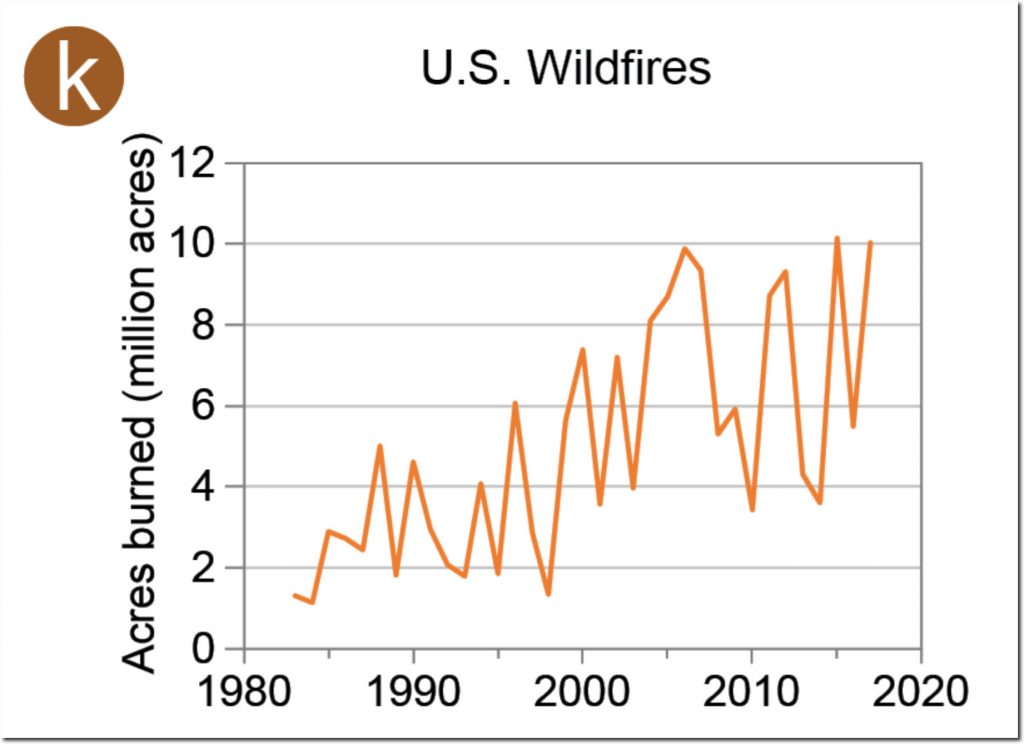
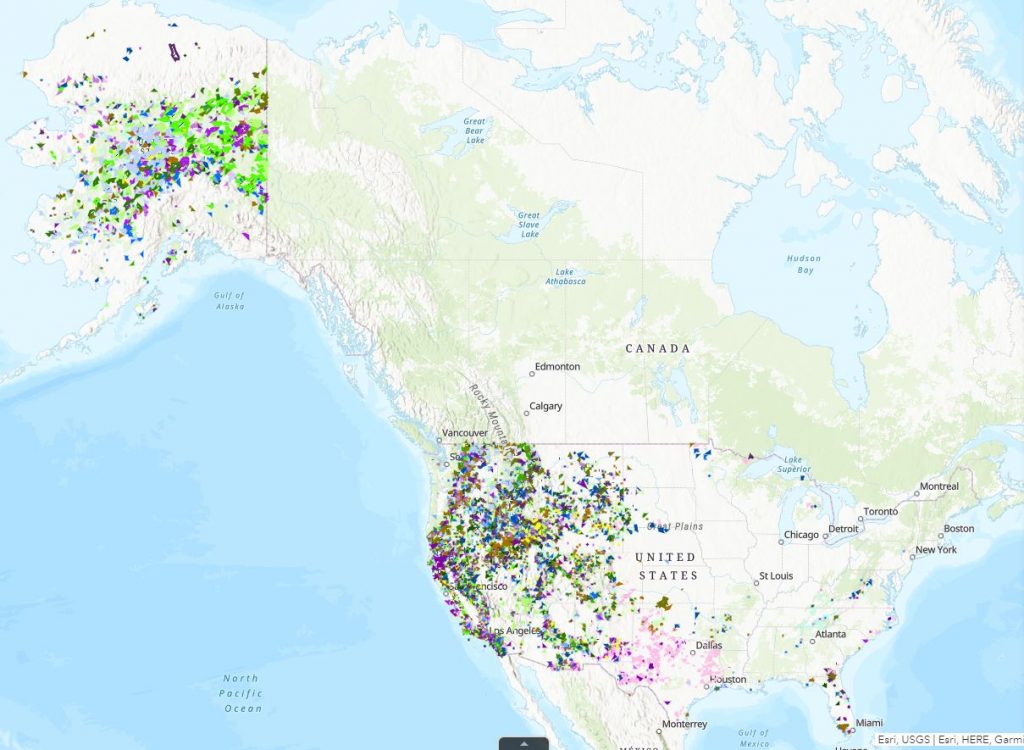
Wildfires in the United States 2000-2018
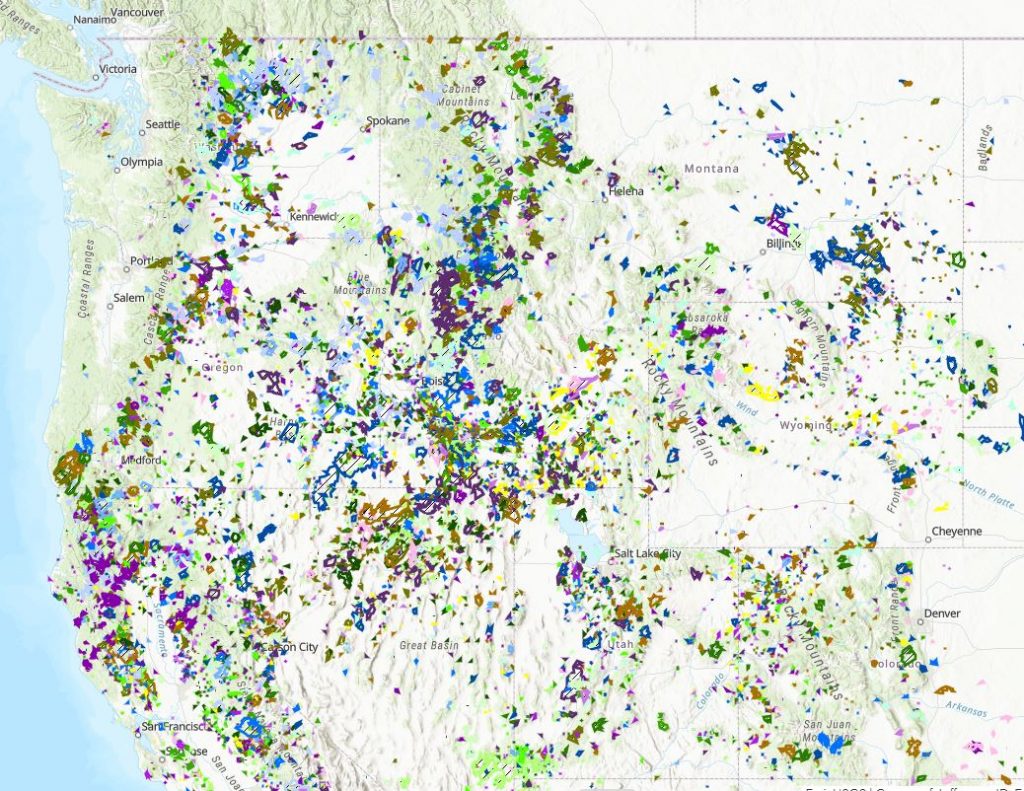
Wildfires in the Northwestern U.S. 2000-2018
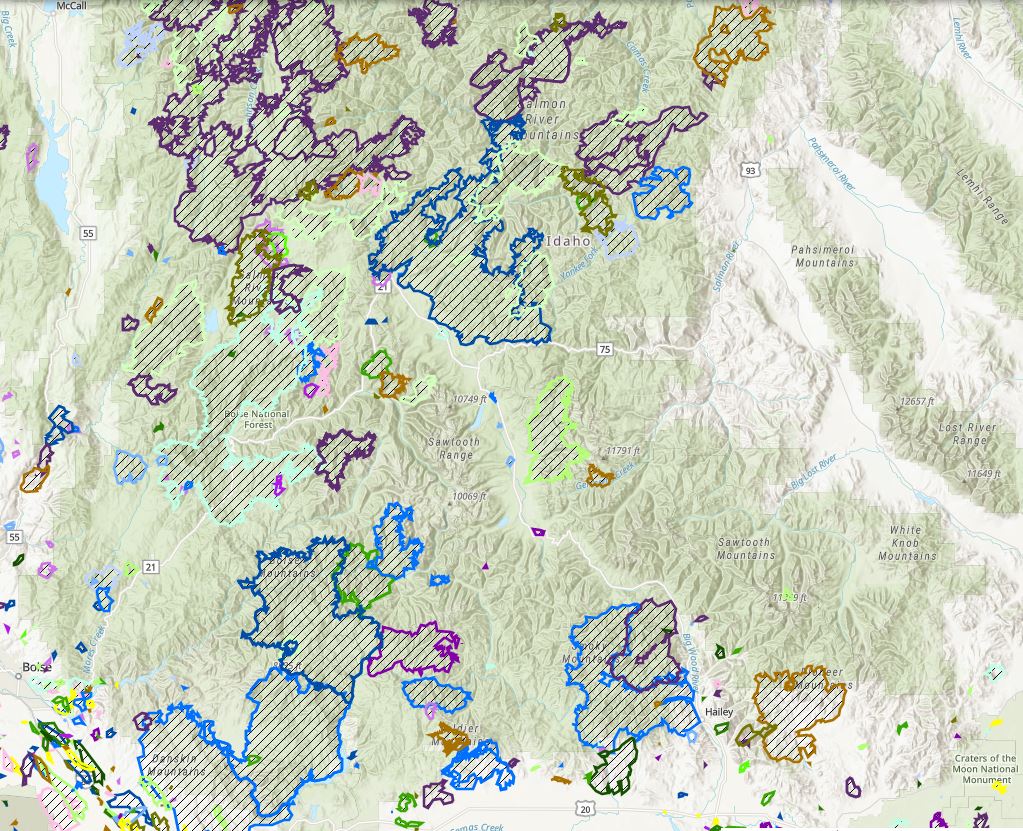
Fires in Jeff’s Backyard 2000-2018
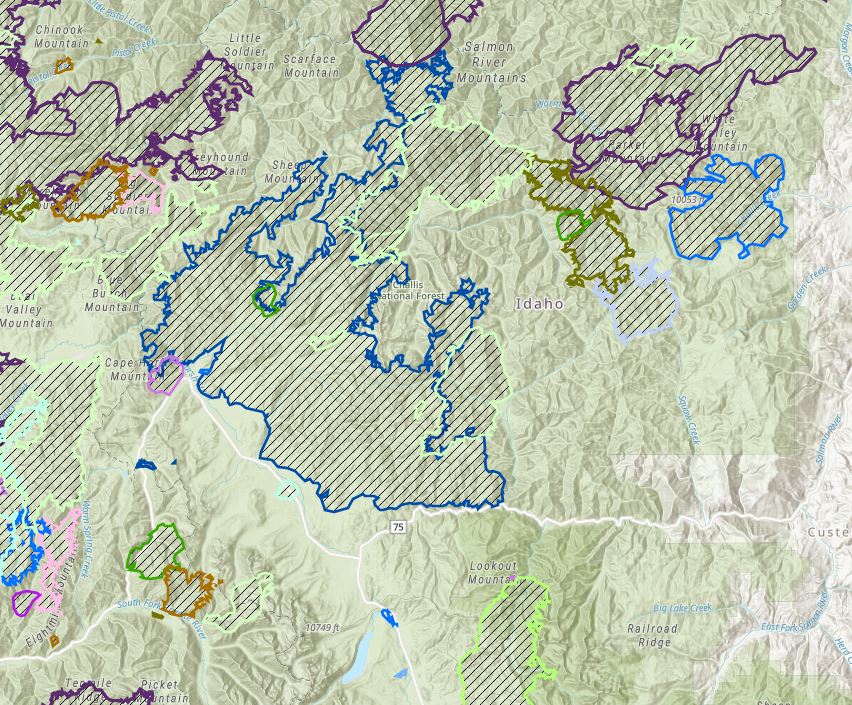
The Halstead Fire 2012 (Blue in center area).
So… while recording a full afternoon of college football, I and the Raptor head out from our cabin in Stanley and travel along the Salmon River to the east.
As most of you know my love and interest in this region is great. Driving along the Salmon (i.e., River of No Return) east from Stanley to Challis is as ruggedly beautiful as it gets. Each and every time I travel this 60 mile section I marvel at the beauty I am afforded. Its equal is the 61 mile section of the Sawtooth Valley south between Stanley and Sun Valley – for completely different reasons. I pinch myself – as to my good fortune – each and every time I make these drives. I never ever take their beauty for granted.
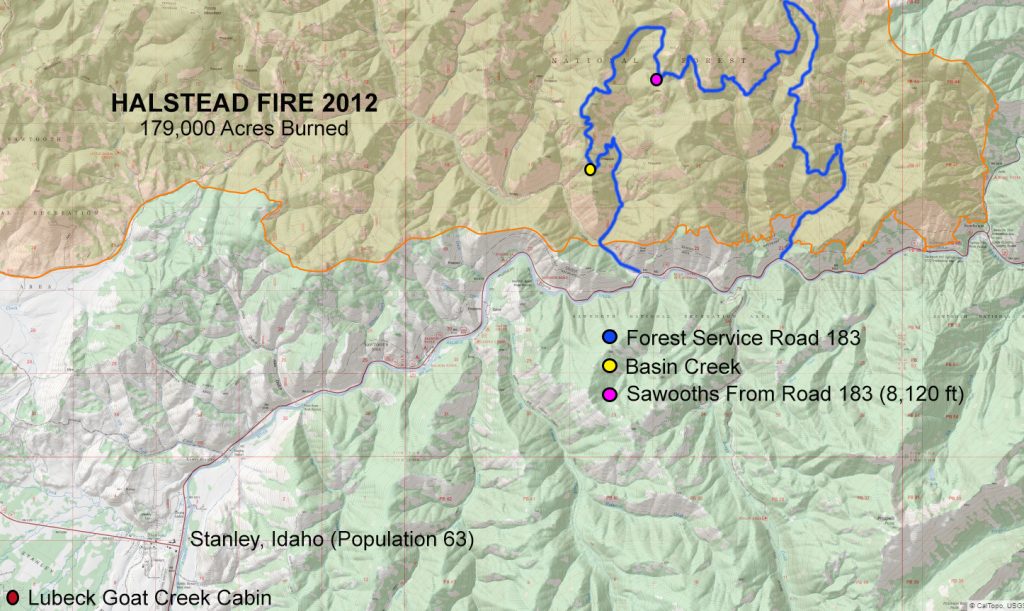
The Trip
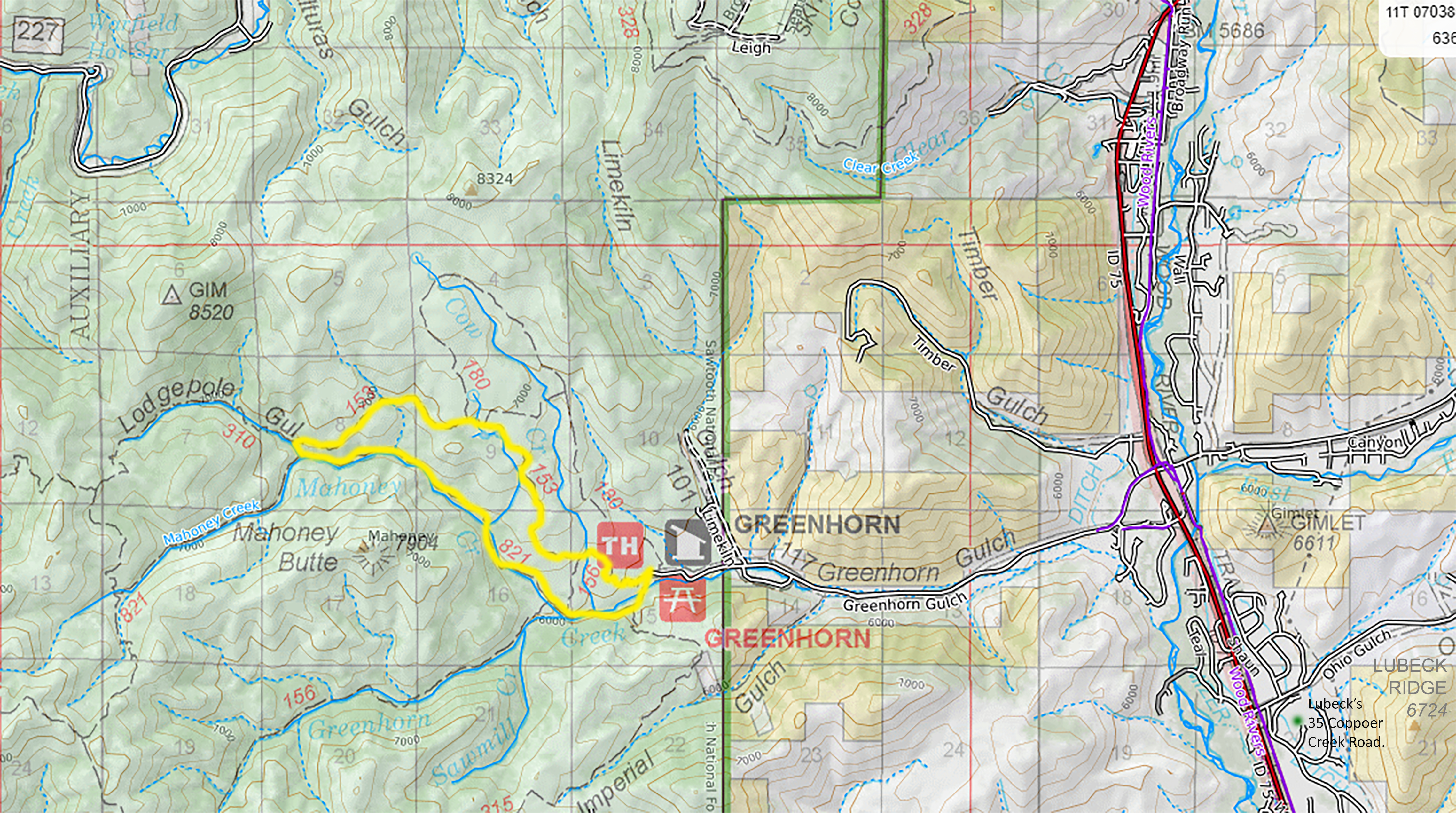
I will test the Raptor by attempting to travel the entire 17+ mile length of Forest Service Road 183 counter clockwise. I will start at Highway 75 and Basin Creek and [sic., hopefully] end at Highway 75 and Lower Harden Creek.
FS Road 183 is demanding for any vehicle. I have been told that travelling the entire length of this road has been impossible for traditional off road passenger type vehicles – including four-wheel drive trucks – since the fire. Some people who have been up to the area in ATV’s say it might now be possible.
I decide to go for it. I pack the truck with all essentials in case I run into a real problem. I call Linda and let her know when I am leaving and where I am going.
The starting point is a few miles after Mormon Bend and a string of Hot Springs that can be enjoyed right along the river on Highway 75.
I turn left from Highway 75 onto Basin Creek. The signs hit me immediately. This is a Mountainous Burn Area with Hazards, Steep Road with Limited Turnouts Ahead, Passenger Vehicles Not Advised. Ford, says it has built, and stands behind the vehicle dealing the issues the signs suggest.
What that means to me is the Raptor is equipped with a 10 Speed automatic\manual transmission six cylinder high turbo engine that produces 480 HP and 520 ft. lbs. of torque. It also means to me the protective under carriage pans, 2W, 4WH, 4WH with locking differential. 4WL, 4WL with locking differential, Hill Descent support, a variety of adjustment levels for the specially designed shock absorbers, the ability to drive through almost 3 feet of water and provide almost 10 inches of clearance for rocks and logs better work. Why? This route will likely put everything into play.
It should be noted that my loving son\business partner\associate Kyle thinks I would benefit from learning and testing as many aspects of the Raptor before any big outing. Quietly and in low key fashion I have read all manuals and tested as many features as possible at least a couple of times for the past few weeks. I have become comfortable moving between 2H and 4WL with Locking differential in 10 speed Manual mode.
The biggest challenge during the test period is passing an old under-powered Recreational Vehicle Motor Home with Wisconsin license plates, with a barking Paris Hilton type lap dog in the back window, pulling a 2nd vehicle that is towing a motor boat – without deliberately driving them off the road. The Raptor performed beautifully, I was at risk.
After about a mile of somewhat tricky travel, I turn right onto Coal Creek Road. Road is a loose term in Idaho, and clearly is not applicable with the terrain before me. Luckily, I knew this condition (to a great degree) ahead of time. The next 4-6 miles are best described as a sketchy Jeep Trail, and a very steep one at that. Most of the 2000+ feet of vertical gain on the trip are accomplished in this section. The effects of the Halstead fire are apparent immediately.
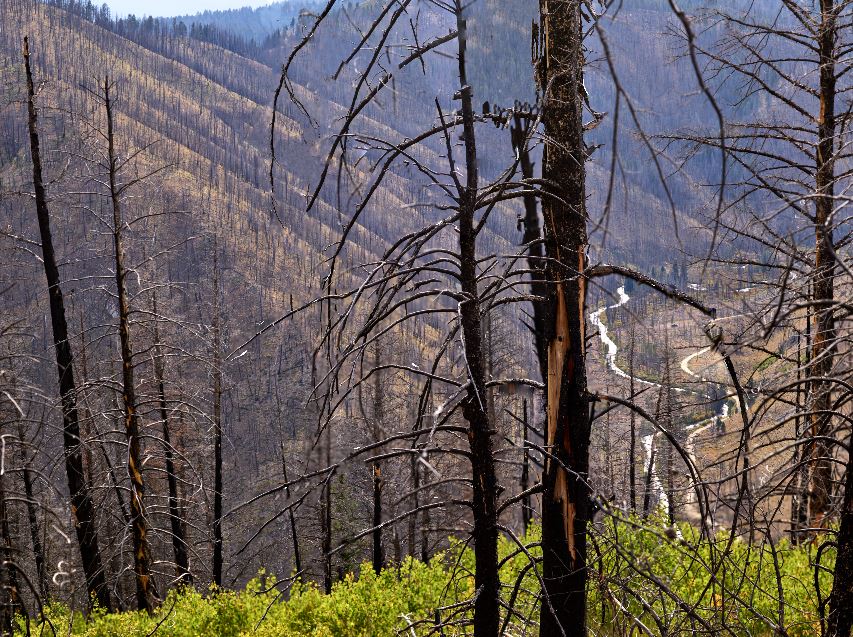
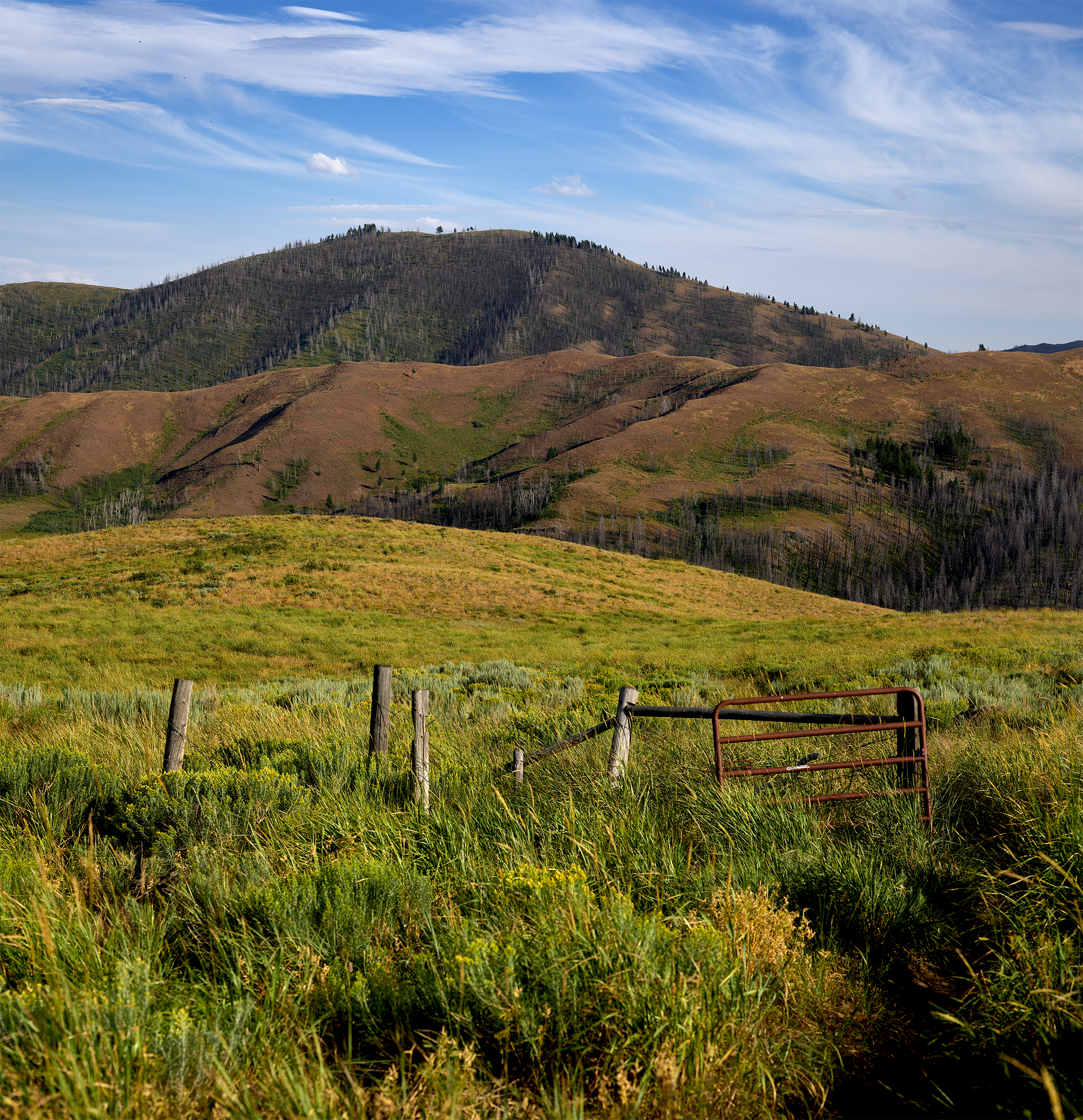
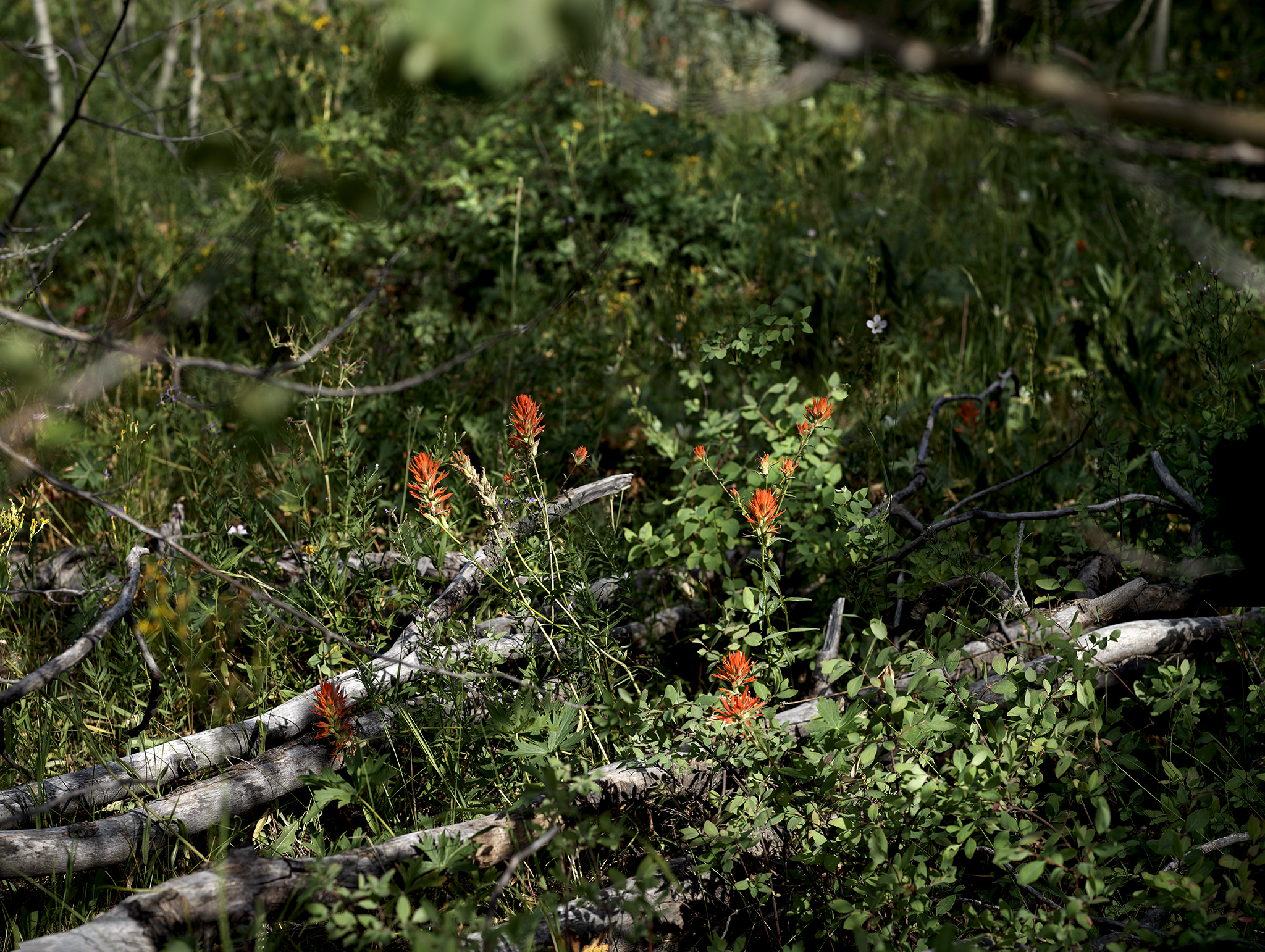
The area around me reflects the result of a nasty torching followed by seven years of ground cover regrowth. The roadbed, if you want to call it that, is punishing. Luckily I have travelled this type of terrain in similar conditions. The Raptor is responding to my changes quickly and smoothly.
I encounter a variety of highly sloped narrow spots, and given the steep uphill angle, I deal with them somewhat blindly. It should be noted, I did not need to do so. Why? I forget the Raptor has a remarkable 360 degree camera the I use most days in the driveway at home to avoid hitting the dogs.
As a result of Kyle’s suggestions, I am travelling matterially slower than I would normally. It is a good thing, as while moving in 4WL with differential at 3MPH over some logs and big boulders a couple of motorized mountain bikes come flying around a corner (downhill) directly towards me. But for the grace of God, (or spiritual unit of your choice) both bikes avoid me by the slightest of margins. I am surprised neither hit me.
The bikers stop and look back to me offering hand signals this condition was their bad and others are coming. Two others follow soon thereafter, but it is on somewhat flat terrain where all parties are in clear view.
In what will prove to be the trickiest and steepest section of the trip, I encounter two guys on ATV’s fully loaded with chain saws and other cutting and clearing equipment. One guy moves on but the other stays to chat.
I ask the guy as to what he is doing and the condition of the road. He responds “We are contractor’s attempting to clear the road. As for you, it will be pretty demanding from this point, but my question is how in God’s name did you make it this far. The worst spots are what you came through and we barely made it ourselves.”
Impressively the guy asks me politely if I have ropes, chains, and other equipment to deal with pulling logs or extracting myself from muddy conditions. I answer yes to all with confidence and legitimacy. The guy concludes “then you should be good to go.” With that I move on.
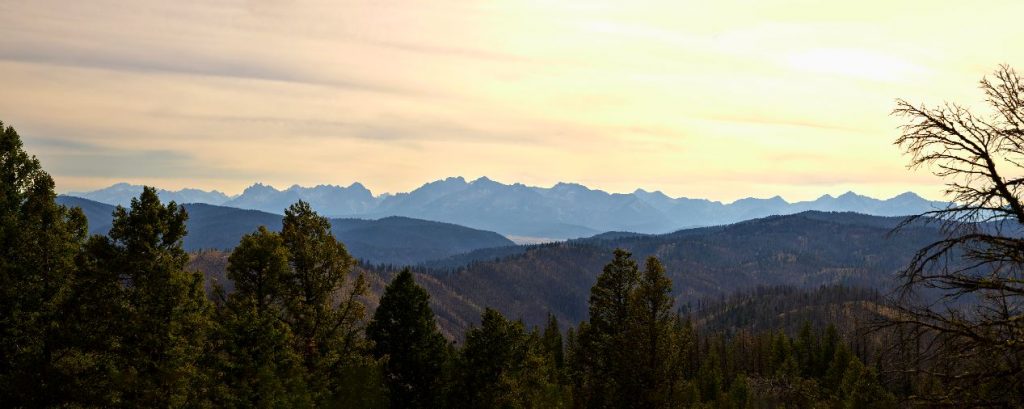
The Sawtooths from the high point of FS Road 183.
The travel for the remainder of the route was exciting. The roadbed while challenging and remarkable at a high elevation was well within the realm of what I have experienced and the Raptor could handle.
I should point out that what the US Forest Service has to tackle and accomplish as part of a Burn Area Environmental Recovery (BAER) project can be astonishing if seen first hand by a laymen or person who knows little to nothing of such an effort. The results of the BAER effort in this area is remarkable.
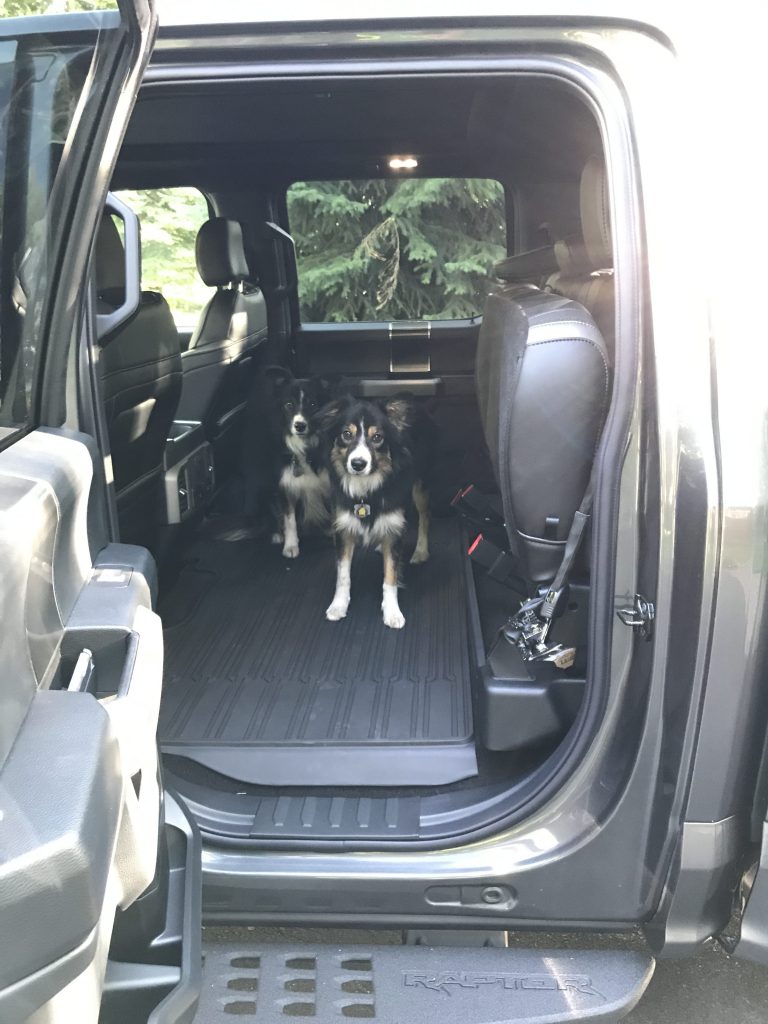
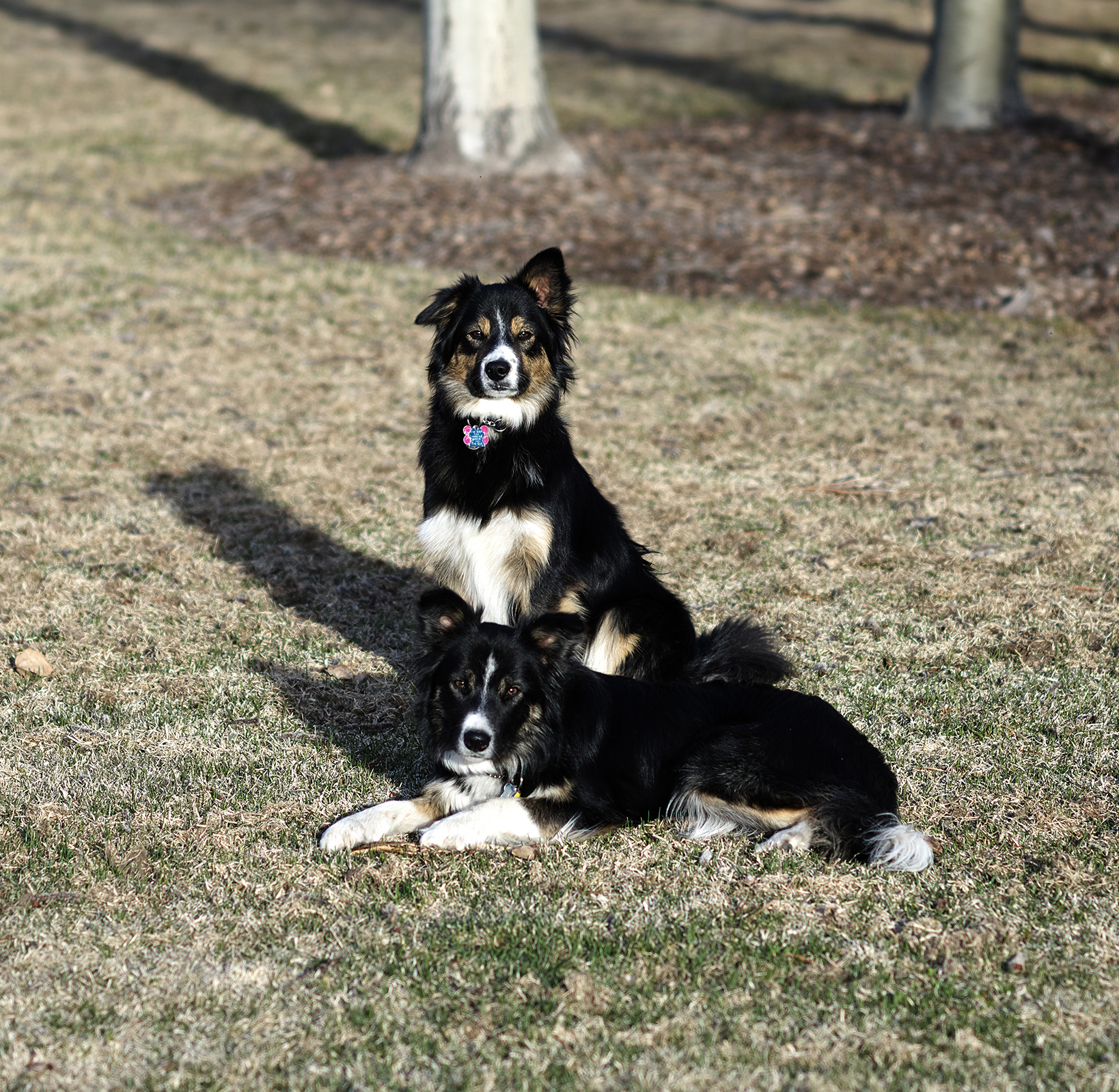
Test Personel