March 2026
M T W T F S S
 1
2345678
9101112131415
16171819202122
23242526272829
3031  

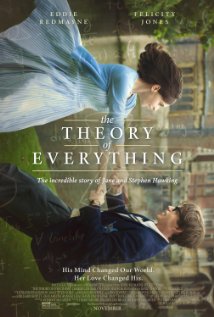
The Theory of Everything – Well Almost

theory

Biopic films are a tricky lot.  The Theory of Everything – the film about the relationship between Steven and Jane Hawking succeeds because the leads feel to be real-life versions of the principle characters.  Directed by James Marsh (AA Man on a Wire, Shadow Dancer) The Theory of Everything is based on the book written by Jane Hawking. The Theory of Everything is not a sappy feel-good film and it does address some of the tougher issues this couple encounters with depth.  However, there are aspects of their life that are addressed more in Check Mark form than in one of full-disclosure.

Eddie Redmayne (My Week with Marilyn, Les Miserables) is engaging and effective as Steven Hawking all the way from able bodied college sophomore to crippled scientist-celebrity.  Felicity Jones (The Amazing Spider-man 2) is winning as Jane Hawking in the same dimension – all the way from demure timid co-ed to supportive struggling spouse who could easily have a professional career of substance of her own.  However, this is England, Cambridge England, Brit’s of the 1960’s.

The journey of this couple (scientific theory, children, physical disintegration, emotional emptiness) is an interesting one that is well told.

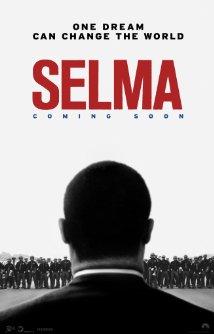
Selma: Human Intuition, Positioning, Timing – Now Just as Then

selma

Selma is a movie not a documentary. It is a finely crafted film about human conflict and racial tension. For the most part Selma does not fall victim to presenting its main participants in grossly exaggerated characterized form; instead it reveals them as human beings (with understandable faults and weaknesses) trying to navigate life based on their upbringing and beliefs using intuition, hope, fear, positioning and timing as their ally.  In the film Selma as in life some succeed, others fail, and many die trying.

Selma when compared and contrasted with the fabric of today’s United States of America, provides a means for its 21st century audience to determine the gains we have made, not made and the ground we have lost on our rights as citizens in the 50 years since its occurrence.

Selma has one portrayal that is somewhat curious to me given the others in the movie are considered to be accurate and true to form.  The implication is that this misrepresentation significantly harms an otherwise interesting film and story.  The Reverend Dr. Martin King is portrayed as pulling an agitated and frustrated US President Lyndon Baines Johnson along on the issue of Voter Rights.  The record and first-hand participants clearly show the opposite to be true.

It is a matter of record (NY Times December 1964 before King and Johnson met) that Johnson talked about the possibility of “a new law that would allow all voters to register at Post Offices.” During their first meeting Johnson did tell King the legislation would have to wait until the timing was right – in that it needed justice department backing and would not fall victim to a filibuster. A few days after meeting with King, Johnson promised is his January 4th State of the Union Address “to remove all remaining obstacles to the right to vote.” During this period Johnson had the Justice department put together the support for this legislation.  The Selma protests started on January 14th with the first attempt at the walk occurring on March 7th.  Before the first attempt at the walk, on January 15th, Johnson and King talked and Johnson encouraged King to push for Voter Rights.  King and Johnson met again in Washington on Feb. 9, and Johnson insisted that King tell the press that the President was going to submit a voting-rights bill. The newspapers not only confirmed this the next day, but also added that the two men had discussed the use of federal registrars, an end to literacy tests and focusing on the most discriminatory areas in the South. They were, in short, agreeing upon the eventual solution to the crisis.  Why were these aspects not included the narrative story-line?  It would have made for fascinating drama in a sub-plot, and enhance a film trying to portray difficult choices and picking the right time to stand and fight.

In the end, Selma is a film not a documentary and its creators have the right to choose the narrative.  For dramatic purposes it includes a fictionalized sub-plot story line about the relationship between two men and events that play a huge role in determining America’s future.

Unbroken – Competent, Measured, Distant and Uninspiring

unbroken

Unbroken the movie – the story of Louie Zamperini based on the book by Laura Hildebrand (Seabiscut) – has all the right ingredients.  However, despite all of the resources available Angelina Jolie’s 2nd directorial effort while competent and hitting all its production marks – feels too measured, distant and ultimately uninspiring. It should be noted, the book biography Unbroken is a remarkable piece of work.  It was engrossing to the point that I read it in one day at home.  Hildebrand effectively tells four remarkable stories where frankness, honesty, grit, perseverance and ultimately humanity jump off the pages.

The easy out would be that no movie can be anywhere as good as the book when it comes to Biopics.  Well… let’s think about that hypothesis.  Hmm… Lawrence of Arabia, Schindler’s List, The Pianist, Ghandi, Papillion, The Hurricane, and Raging Bull quickly come to mind.

Frankly the result that is Unbroken the movie is a bit surprising.  The talent lineup (see notes) for major aspects of the behind the camera work would challenge the Murderer’s Row teams of the 1918 or 1927 NY Yankees. Their work in this movie cannot be called out for being weak or even subpar.  In fact on their own the product is good, but somehow they do not seem compelling when combined.

Also, Jack O’Donnell (as Zamperini), Domhnall Gleeson (as Phil) and Takamasa Ishihara (as Watanabe) are good in their roles, but something does not allow them to connect emotionally.

The bottom-line is that Unbroken misses on a couple of fronts.  Aspects of Zamperini’s life are treated in a bland, stiff, almost obligatory anecdotal fashion or missed completely, and in the end it does not feel personal or passionate.

Notes:

Screenplay: Ethan and Joel Cohen (Fargo, Blood Simple, No Country for Old Men), Richard LaGravense (The Fisher King, Little Princess, The Horse Whisperer) and William Nicholson (Gladiator, Les Miserables).  These guys are heavy hitters, but what is revealing is that three different writing styles were required and attributed to the film – that means bad news in Hollywood.  And if you are expecting some line of dialog that the Cohen’s always produce – it is not in this film.

Music:  Andre Desplat (6 AAN for Philomena, Argo, The Kings Speech, The Fantastic Mr. Fox, The Curious Case of Benjamin Button, The Queen).  My favorite of his recent work is the score for Zero Dark Thirty.  How was that not nominated?  I listen to “Seals Take Off” almost every day.  I was not humming the music theme one moment afterward and the End Title’s song by Coldplay seems remarkably out of place – no matter how much you like Chris Brown – of which I do.

Cinematography: Roger Deakins (11 AAN for Shawshank Redemption. Fargo, Kundun, Oh’ Brother Where Art Thou, The Man Who Wasn’t There, No Country for Old Men, The Assassination of Jesse James by the Coward Robert Ford, The Reader, True Grit, Skyfall, Prisoners).  Wait a minute! How was Deakins not nominated for Mountains of the Moon or Courage Under Fire????  Deakins work here does not feel as deep, dark or grande as normal.

Editing:  William Goldenberg (AA Argo) and Tim Sqyres (AAN Life of Pie).